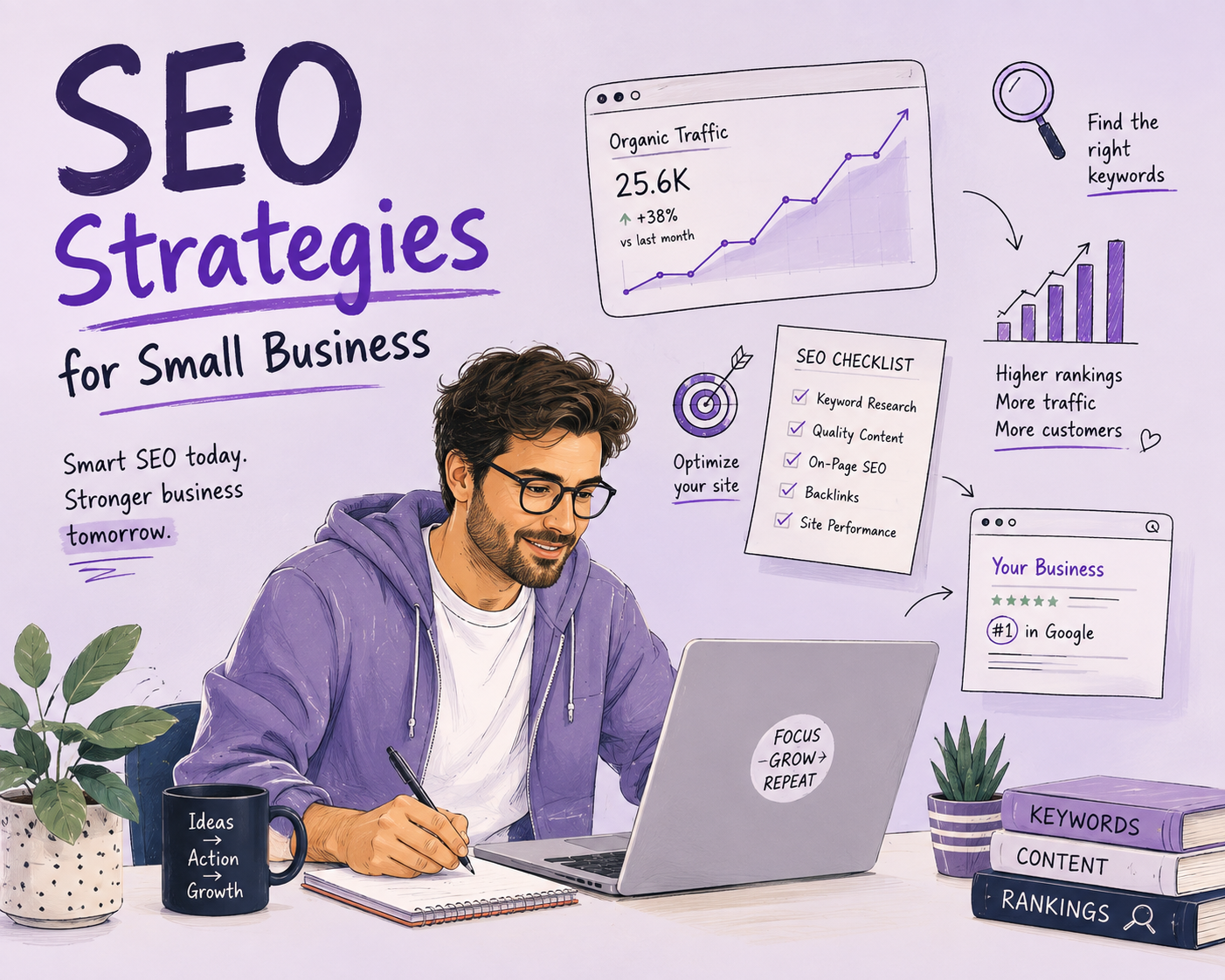
Growing a small business online can feel like trying to get noticed in a crowded marketplace. You may have a great product, excellent service, and loyal customers, but if your website does not appear when potential customers search for what you offer, growth becomes much harder. That is where SEO Strategies for Small Business can make a measurable difference. Search engine optimization helps your website become easier for search engines to understand while also making it more useful for the people who visit it.
The good news is that small businesses do not need enormous budgets to start seeing SEO benefits. A focused SEO plan for small business can begin with keyword research, useful content, technical improvements, local visibility, and consistent measurement. The key is not to try every SEO tactic at once. Instead, build a practical system, improve one area at a time, and give your efforts enough time to produce meaningful results.
Why SEO Matters for Small Businesses
SEO gives small businesses an opportunity to compete for attention based on relevance and usefulness rather than advertising budget alone. When someone searches for a product, service, solution, or business in your area, appearing prominently in the results can introduce your brand at exactly the moment that person needs it. Organic search can also continue generating visits after a page has been published, making SEO a valuable long-term marketing channel.
How SEO Supports Long-Term Business Growth
Effective SEO for business growth is about attracting the right visitors, not simply increasing traffic. A hundred people who genuinely need your service can be more valuable than thousands of visitors who have no intention of becoming customers. By targeting relevant search terms and creating pages that answer specific questions, you can bring qualified prospects to your website throughout the customer journey.
SEO can also strengthen brand credibility. A well-structured website with useful information, clear contact details, strong reviews, and authoritative content gives visitors more reasons to trust your business. Over time, this combination of visibility and credibility can support leads, sales, inquiries, and repeat business.
Step 1: Define Your SEO Goals
Before changing your website, decide what you want SEO to accomplish. Your objective might be generating more phone calls, increasing online sales, attracting service inquiries, getting more visitors to a physical location, or building awareness within a particular market. A clear goal prevents your SEO campaign from becoming a collection of disconnected activities.
Choose the Right KPIs
Track metrics that connect search performance to business outcomes. Useful measurements include organic traffic, keyword visibility, qualified leads, conversion rate, phone calls, form submissions, and revenue generated from organic search. Rankings can be helpful, but a number-one position is not automatically valuable if the keyword does not attract potential customers.
Step 2: Find the Right Keywords
Keyword research provides the foundation for effective SEO Strategies for Small Business. Start by listing the products, services, problems, and questions your customers commonly search for. Then expand those ideas into specific phrases that reflect real search intent.
Target Long-Tail and Local Keywords
Broad keywords can be extremely competitive, especially for a new or smaller website. Long-tail phrases are often more specific and can better reflect what a potential customer actually wants. For example, instead of targeting only “plumber,” a local company could target phrases such as “emergency plumber in [city]” or “water heater repair near me.”
Understanding search intent matters just as much as finding keywords. Someone searching “best accounting software” may want information, while someone searching “accountant for small business near me” may be ready to contact a provider.
Step 3: Optimize Your Website
Once you know which searches matter, make sure your website communicates its relevance clearly. Each important service or product should have a dedicated, useful page rather than forcing every topic onto one generic page.
Improve Titles, URLs, and Headings
Create descriptive title tags and headings that naturally include your primary topics. Keep URLs simple and readable, and make sure each page has a clear purpose. Internal links can connect related pages and help visitors discover additional information while giving search engines context about your website structure.
Avoid stuffing keywords into every sentence. Modern SEO works best when keywords appear naturally within genuinely helpful content.
Step 4: Create Helpful Content
Content is one of the strongest tools available to a small business because it allows you to answer the questions customers ask before they buy. Create blog posts, service guides, comparison pages, FAQs, tutorials, case studies, and other resources that address real customer needs.
Write for People and Search Engines
AEO, or Answer Engine Optimization, adds another important layer. People increasingly search using conversational questions and expect direct answers. Structure content so important questions are easy to identify and answer them clearly near the beginning before providing additional context.
Use descriptive headings, concise definitions, relevant examples, and trustworthy information. Instead of writing an article simply because a keyword has search volume, ask whether the content genuinely helps someone make a decision or solve a problem.
Step 5: Build a Local SEO Presence
For businesses serving specific geographic areas, local SEO for small business should be a core part of the strategy. Keep your business name, address, phone number, opening hours, website, and service information accurate and consistent across important online profiles.
Your Google Business Profile deserves particular attention. Add accurate categories, services, photos, business information, and regular updates where appropriate. Encourage genuine customers to leave reviews and respond professionally to them.
Local content can also strengthen geographic relevance. Create useful pages for the locations you genuinely serve, but avoid producing dozens of nearly identical pages with only city names changed.
Step 6: Improve Website Speed and Mobile Experience
A beautiful website is not very useful if visitors struggle to use it. Check how quickly pages load, especially on mobile devices, and remove unnecessary elements that make the site slower or harder to navigate.
Make buttons easy to tap, text readable, navigation intuitive, and forms simple to complete. Technical SEO also includes areas such as crawlability, indexing, redirects, broken links, structured data, and HTTPS. You do not need to become a developer, but regular technical checks can prevent important pages from being overlooked by search engines.
Step 7: Earn Quality Backlinks
Backlinks are links from other websites to your site, and relevant, trustworthy links can strengthen your site’s authority. Small businesses can earn them naturally by publishing original research, creating useful resources, participating in legitimate industry organizations, supporting community initiatives, or developing content that others genuinely want to reference.
Quality matters more than quantity. Avoid buying large numbers of questionable links or participating in manipulative link schemes. One relevant mention from a respected industry or local website can be more useful than dozens of unrelated links.
Step 8: Measure, Update, and Improve Your SEO Plan
SEO is not a one-time website project. Search behavior changes, competitors publish new content, and older pages can become outdated. Review your performance regularly and identify pages that are gaining impressions but need stronger content, pages receiving traffic but producing few conversions, and topics where competitors provide better answers.
Your SEO plan for small business should therefore operate as a cycle: research, publish, measure, learn, and improve. Use analytics and search performance data to decide what deserves attention next. Small, consistent improvements can compound over time and create a stronger organic presence than a short burst of SEO activity followed by months of inactivity.
FAQs About SEO for Small Businesses
How long does small business SEO take?
SEO typically requires patience because search engines need time to discover, evaluate, and rank changes. Results can vary significantly based on competition, website history, content quality, authority, technical health, and the search terms being targeted.
Is SEO worth it for a small business?
Yes, SEO can be worthwhile when it is aligned with actual business goals. It can help small businesses attract people who are actively searching for their products, services, or solutions instead of relying entirely on paid advertising.
How much does small business SEO cost?
The cost depends on whether you handle SEO yourself, hire a freelancer, or work with an agency. Expenses may include content creation, technical work, tools, link development, local SEO, and ongoing optimization.
Can I do SEO without an agency?
Absolutely. Many foundational tasks can be handled internally, including keyword research, content creation, on-page optimization, Google Business Profile management, internal linking, and performance monitoring.
What is local SEO for small business?
Local SEO helps businesses become more visible for searches connected to a specific geographic area. It includes optimizing business information, local listings, reviews, location-focused content, and other signals that help customers find nearby businesses.
What should a small business SEO plan include?
A practical plan should include measurable goals, keyword research, website optimization, useful content, technical SEO, local SEO where relevant, link acquisition, conversion optimization, and regular performance reviews.
How do I know if SEO is working?
Look beyond rankings. Monitor organic traffic, qualified leads, sales, calls, form submissions, conversions, and other metrics connected to your business objectives. Improvements in these areas provide stronger evidence of SEO’s commercial value.
What is the most important SEO strategy for a small business?
There is no single tactic that works for every company. A strong starting point is understanding your customers’ search intent and creating a technically sound website with genuinely useful, relevant content that makes it easy for visitors to take the next step.
Conclusion
The best SEO Strategies for Small Business are practical, focused, and consistent. Start by defining what you want SEO to accomplish, research the searches your customers actually use, optimize your website, publish genuinely helpful content, strengthen your local presence, and monitor the results. You do not need to dominate every keyword to succeed. You need to become highly visible for the searches that matter to your business.
Think of SEO as building a digital storefront on a busy street. The right keywords help people find the storefront, useful content gives them a reason to enter, a good user experience keeps them there, and clear calls to action make it easy to become a customer. Keep improving each part, and your website can become a dependable source of SEO for business growth rather than simply another online brochure.